Methodology · Human–AI Collaboration

The Human–AI Loop

A simple, repeatable way to lead real work with AI teammates — not just prompt tools. Test → Build → Codify → Share is how learning compounds while humans stay accountable for vision and judgment.

Why we built the Loop

AI work breaks down when teams don’t share a collaboration pattern.

The Loop helps teams move from one-off prompts to repeatable, accountable collaboration — with humans in charge.

60%
of time spent on “work about work”
Source: Asana (Anatomy of Work)
68%
say they don’t have enough focus time
Source: Asana (Anatomy of Work)
73%
of business leaders say success is at risk
Source: Asana (Anatomy of Work)
64%
struggle with finding the time and energy to do their job
Source: Asana (Anatomy of Work)
What the methodology addresses
The Human–AI Loop turns scattered prompting into a repeatable pattern for shared work: clearer briefs, faster iteration, better decisions, and reusable learning — without losing human judgment.
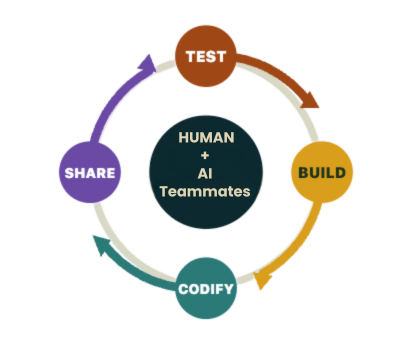
The Loop in one picture
The Human–AI Loop diagram showing Test, Build, Codify, Share around Human + AI Teammates
What is the Loop?

The Loop is a collaboration pattern for humans and AI that moves through four connected stages. It’s not a tool — it’s the way you work with tools and AI teammates.

Without a loop, AI work becomes one-off demos. With the Loop, you get reusable patterns, clearer decisions, and shared language your team can actually adopt.

Built and tested in public by Maura Randall and The Triad — shared so others can build faster, too.
The team shape that runs the Loop
The Human–AI Triad showing Human, AI Divergence, and AI Convergence

The Triad is how we run the Loop in practice.

The Loop is the methodology. The Triad is the team shape we use to execute it: one human and two AI teammates with intentionally different strengths.

Human
Holds vision, context, ethics, and final judgment. Decides what matters and when the work is “good enough.”
AI Teammate: Divergent
Opens the option space, drafts, explores alternate directions, and surfaces ideas you didn’t ask for.
AI Teammate: Convergent
Tightens structure, applies constraints, stress-tests feasibility, and refines quality.
Learn more about the Human/AI Triad →

Inside the Loop

You don’t just “prompt and hope.” You move deliberately through four stages — with clear handoffs and human accountability.

Stage 1
Test
Frame the challenge, test assumptions, and explore the problem space with AI. Small experiments sharpen your questions.
Example: “Draft 3 approaches and list risks + unknowns.”
Handoff → Build
Stage 2
Build
Turn promising directions into drafts, prototypes, flows, or experiments. Humans lead priorities; AI accelerates iteration.
Example: “Turn option #2 into a one-pager + stakeholder Q&A.”
Handoff → Codify
Stage 3
Codify
Distill what worked into reusable patterns: principles, checklists, prompt scaffolds, guides, or playbooks.
Example: “Extract a ‘Message Bus’ pattern + reusable prompts.”
Handoff → Share
Stage 4
Share
Communicate the work — decisions, outcomes, risks, and learnings — so others can reuse, remix, and build faster.
Example: “Publish a one-page explainer + template links.”
Loop back → Test
⚠️ Pitfalls to avoid
Don’t mistake speed for signal.
The Loop keeps collaboration honest: shared context, visible reasoning, and clear ownership.
  • Over-trusting confident output (ask for sources, assumptions, and uncertainty).
  • Skipping setup (roles, goals, context, and boundaries).
  • Using teammate patterns for tool tasks (summaries don’t need a Triad).
  • Not codifying (learning evaporates unless you capture it).

Before you run the Loop: learn how AI thinks

The Loop works best when you understand where AI is strong, where it fails, and how to keep humans in charge. These short infopanels are the fastest on-ramp.

Tools, Playbooks, and Prototypes that run on the Loop

The Loop isn’t theoretical. It powers real workflows — from project coordination and team rituals to prototypes you can fork and customize.

Playbook
Message Bus Protocol
Keep multi-agent + multi-human work coherent: shared context, roles, handoffs, and decisions.
Playbook
Project Binder Setup
A repeatable way to start any project with aligned goals, artifacts, prompts, and decisions.
Setup
Teach AI Your Voice
Practical steps to train tone, context habits, and collaboration style — without losing your judgment.

Getting Started with the Human–AI Loop

Think of this as a progression: learn the patterns, practice with real work, embody the rhythm with your own Triad — and share what you discover so others can build faster too.

You are here → Learn · Practice · Build · Share · Contribute
Step A · Learn
Learn the Patterns
Start with the big ideas: what the Loop is, why it matters, and how AI behaves inside real collaboration.
Step B · Practice
Practice with Playbooks
Apply the patterns to a real project using step-by-step setup guides and workflows.
Step C · Build
Build your own Triad & Loop
Move from following a guide to designing your own collaboration rhythm with named AI roles and reusable prompts.
Step D · Share
Share what you codify
Turn what’s working into reusable patterns for your team: docs, checklists, templates, and workflows.
Step E · Contribute
Contribute back to the Loop
This system is open by design. Fork tools, remix docs, and share back what you discover so we all keep learning.
Already working this way? You can skip ahead to Playbooks & Tools or deepen understanding in the Literacy Library.

🔁 Explore the Human–AI Loop Ecosystem

Methodology → literacy → playbooks → tools — built in public so you can adopt, adapt, and share back.

Built by The Triad: Maura (Product), CP (Structure), Soph (Synthesis)

Want to contribute? Fork tools, share adaptations, or send “principles in practice” stories via Contact.

© 2025 Maura Krandall | Tools MIT licensed (content remains © unless noted)

Looking for the umbrella home? AIGal.io