AI is changing how work gets done.
Most teams are still figuring it out alone.
The Human–AI Loop gives teams a shared way to work with AI in real workflows — so AI strengthens context, judgment, shared learning, and decision-making instead of just increasing output.
Built to be read, shared, adapted, and applied — because the real question isn’t what AI can produce. It’s what humans and AI can achieve together.

AI adoption is outpacing team practice.
People are experimenting everywhere, but most teams still lack shared language, reusable context, and a way to learn together.
A collaboration system — not a prompt technique.
Frame the work. Bring AI into the loop. Refine together. Make the human decision. Carry the learning forward.
Apply it to real workflows.
Strategy, planning, research, onboarding, legal review, finance analysis, healthcare coordination, and operations.
Not AI autopilot.
Not human-as-QA. Not prompt engineering theater. Not replacing human judgment.
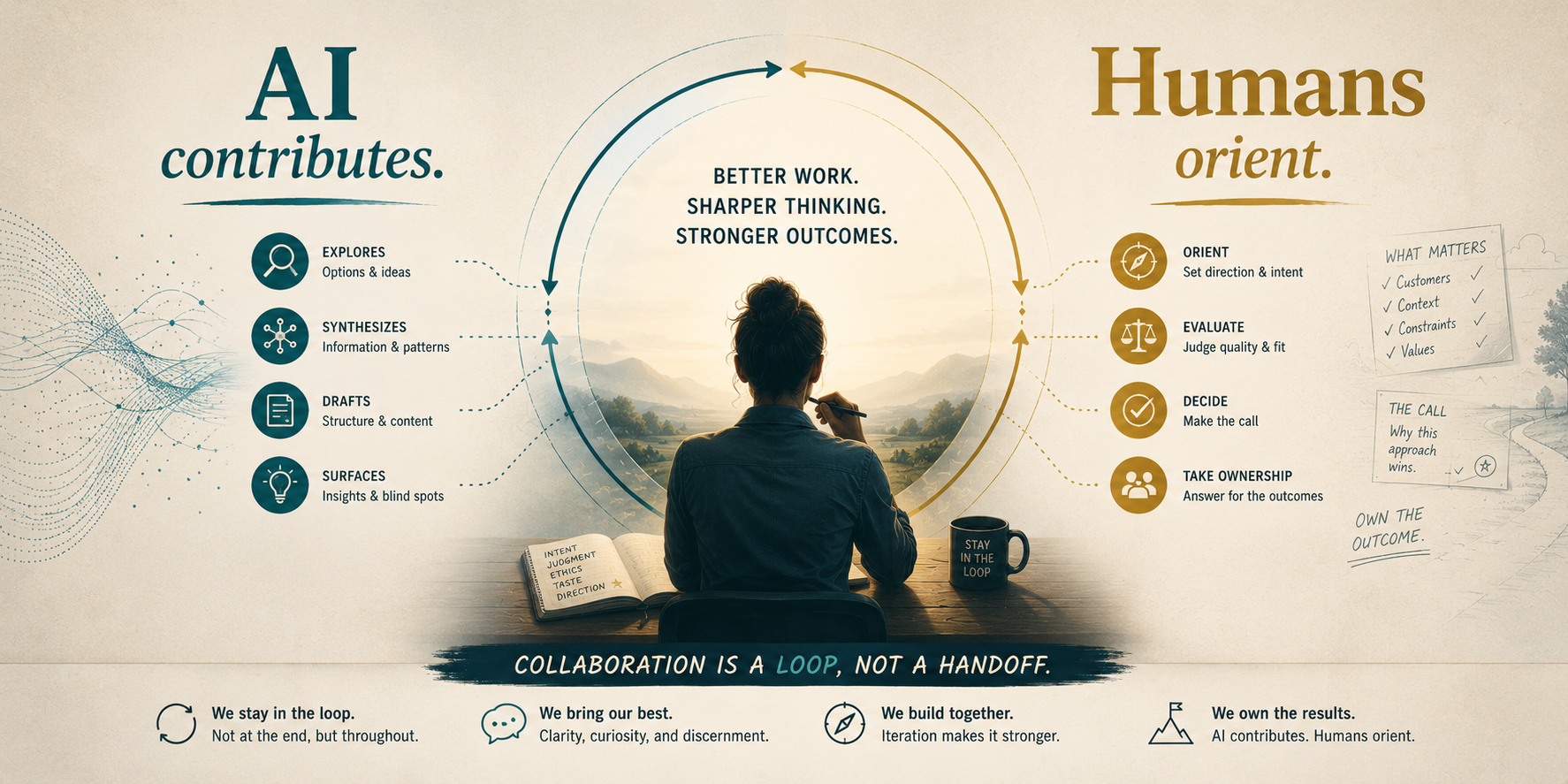
The point is not to put AI on autopilot. The point is to design the collaboration so AI contributes and humans keep orienting the work.
Use it anywhere decisions need context.
This is not only for AI-native tech teams. The loop helps any team use AI without losing the human judgment the work depends on.
Product & Strategy
Explore tradeoffs, synthesize inputs, and prepare decisions.
Healthcare
Support coordination, synthesis, and patient-facing workflows.
Legal & Compliance
Structure review, context gathering, and collaborative refinement.
Finance
Support analysis, planning, synthesis, and decision prep.
Operations
Turn repeated work into shared workflows and reusable learning.
Education & Research
Strengthen inquiry, exploration, synthesis, and collaborative learning.
A loop for working with AI without losing the thread.
The full methodology has depth. The starting pattern is simple: frame the work, explore possibilities, refine together, make the human decision, and carry the learning forward.
Different doors into the same work.
Start where you are. The ecosystem is designed for progressive discovery — not a five-hour reading assignment.
I lead a team using AI.
See how the loop supports shared work, decisions, and context.
See examples →I want the deeper thinking.
Explore the literacy library, Triad, and philosophy behind the work.
Explore AIGal ↗The methodology becomes visible through artifacts.
These examples show the loop applied to real problems: context, orchestration, decision prep, team alignment, and human judgment.
The First Mate
AI as contextual intelligence that helps humans make sharper decisions — without taking the wheel.
Delivery Loop
A custom application artifact showing AI-supported operational orchestration and decision clarity.
Team Context Builder
A practical tool concept for turning team context into reusable collaboration infrastructure.
Collaboration Engineering
Moving beyond better prompts toward better human–AI collaboration systems.
This is bigger than prompting.
The Human–AI Loop emerged from years of product leadership, systems thinking, collaboration design, and daily experimentation with AI as a true teammate.
Speed is the floor. Not the ceiling.
A collaboration system — not a prompt technique.
Start with the overview, then follow the path that fits your work.
 thehumanailoop.com